

Introduction
The modern humanitarian professional is a figure born from the crucible of past failures. The volunteer-dependent responses to crises in Biafra (1970) and Rwanda (1994) starkly revealed that good intentions alone were insufficient. These events catalyzed a shift, underscoring the necessity for a corps of professionals equipped with technical skills and specialized knowledge, not just a vocational calling for humanity.
This evolution spurred a wave of institutionalization and standardization from the 1990s onward, establishing the benchmarks for a new kind of aid worker. The result is the contemporary humanitarian: a managerial and technical expert, often with a strong administrative background. This professional identity is defined by a complex, and often conflicting, blend of technocratic capabilities and a deeply ingrained set of humanitarian ideals.
The Current Crisis: The Great Contraction of 2025
The year 2025 is being defined by a severe contraction of the humanitarian sector. This downturn was triggered by the United States' decision on January 24th to freeze humanitarian funding with immediate effect. This move was quickly emulated by other key donor countries, including the United Kingdom, Germany, France, the Netherlands, Switzerland, and Sweden.
This crisis, however, did not emerge from a vacuum. It is an acceleration of a trend that began in 2024. For over a decade, the growth in humanitarian funding, while always failing to meet the ever-expanding global needs, was at least steady. Last year marked a turning point, with total funds dropping by 11%—the first such decrease in more than ten years.
The Human Component: Workforce Dynamics and Wellbeing
To understand the full impact of this contraction, one must look beyond the budget lines to the demographics and operational realities of the workforce itself. The sector is characterized by distinct patterns of entry, retention, and attrition that are likely to be exacerbated by the current crisis.
Age and Career Lifecycle The humanitarian workforce typically exhibits a bimodal age distribution. There is a significant peak of entry-level professionals in the 25–35 age range, driven by early-career enthusiasm and volunteerism. A second, smaller peak exists for senior experts aged 55–65, often returning to the field after other careers. Between these two groups lies a "missing middle." Data suggests a high attrition rate as workers reach their mid-30s, often due to the incompatibility of field life with raising a family. Consequently, the "active life" of a field worker is surprisingly short; for many, it is less than a decade. Surveys indicate that over 45% of humanitarian professionals expect to remain in the sector for 10 years or less.
The Physical and Emotional Weight The toll of this work is measurable and severe. The physical weight of the profession has increased as the security environment deteriorates; 2024 was recorded as the deadliest year in history for aid workers, with 281 fatalities globally, driven largely by conflicts in Gaza and Sudan.
The emotional weight is equally heavy. The prevalence of Post-Traumatic Stress Disorder (PTSD) among aid workers is estimated at up to 30% upon return from assignment. Furthermore, burnout rates range significantly, with some studies showing between 8.5% and 32% of workers suffering from emotional exhaustion. Alarmingly, health data suggests that 28% of workers report a deterioration in their physical health following a mission, often persisting months after their return.
How to Monitor the Situation: A Dashboard Approach
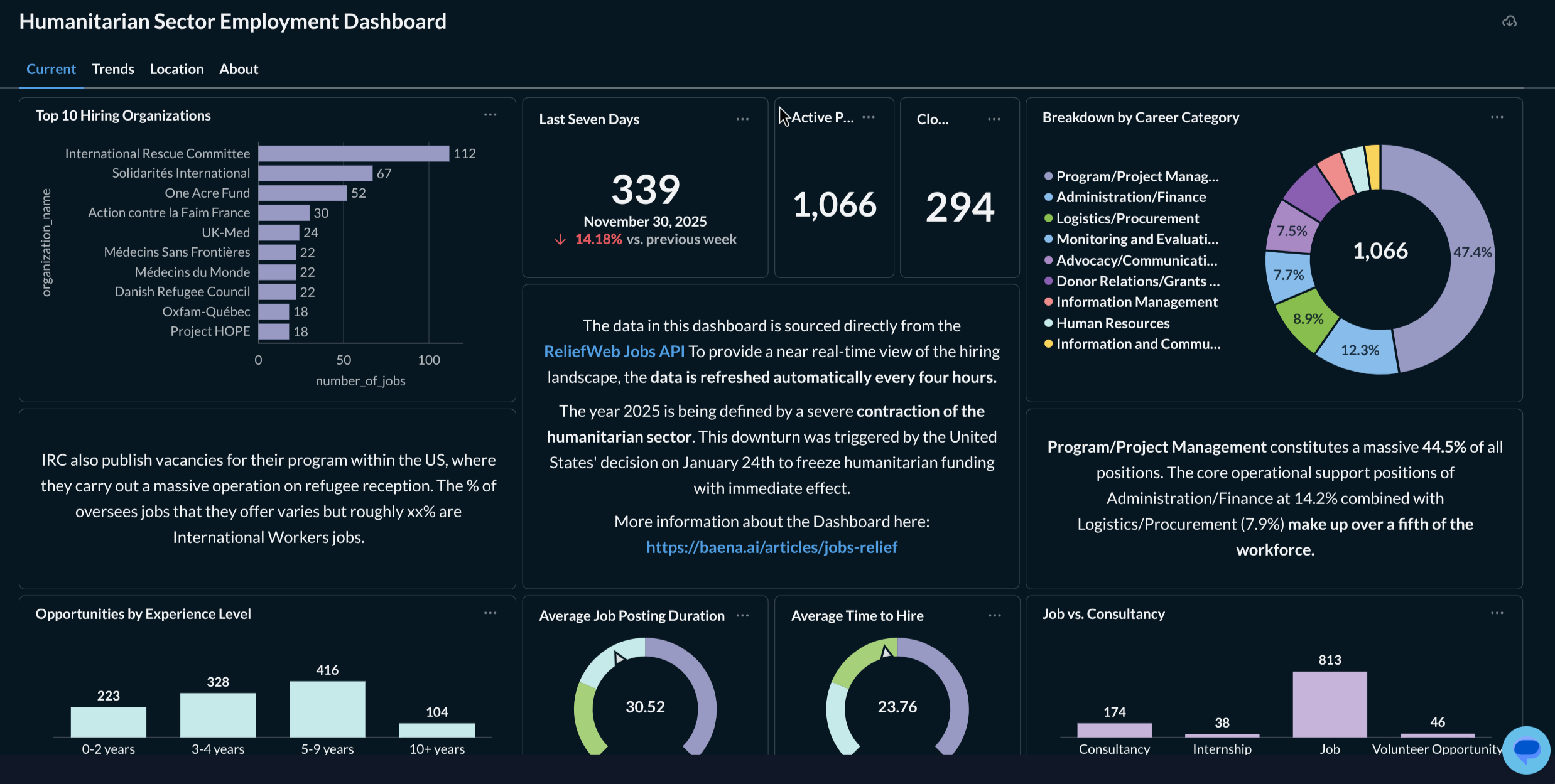
To track the impact of these funding cuts on the workforce, I have developed a dashboard that provides a daily, high-level overview of the humanitarian job market.
The dashboard automatically collects and processes job posting data using the API from ReliefWeb, one of the sector's primary information hubs. It then visualizes key trends, allowing for a quick assessment of how the market is changing. The underlying SQL queries and automation flows used to power this tool are open-source and available for review in this GitHub repository and this entry of my blog: Building a Humanitarian Jobs Dashboard.
While invaluable for a "sneak peek" into market dynamics, a dashboard has its limits. It reveals trends and correlations but cannot provide the rigorous, in-depth analysis needed to draw definitive conclusions. The interpretations that follow are therefore informed hypotheses, not final judgments.
Update — August 2026. The dashboard has been rebuilt. What you see embedded below is a Nuxt front end, not an embedded Metabase dashboard. The pipeline behind it is unchanged — ReliefWeb API → n8n → Postgres, with LLM extraction on the job descriptions — and the queries are the same ones. Only the presentation layer moved. The reasoning is at the end of this article.
Interpretation: Reading the Data
The impact of the 2025 funding crisis is clear and immediate. Monthly job postings have been in a sustained downturn since the February funding freeze.
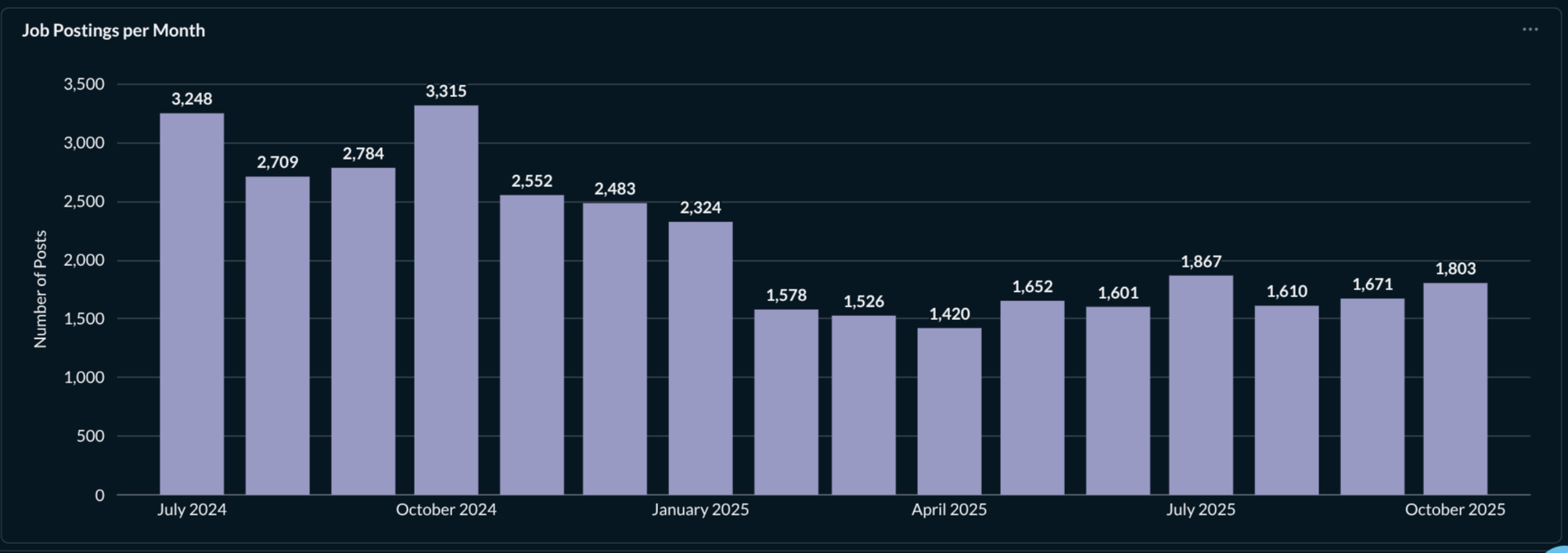
While a minor recovery in postings was observed in July, this more likely signals that the market is beginning to normalize at a new, much lower baseline rather than indicating a true recovery.
Notably, short-term consultancy roles appear largely impervious to this downward trend. This is a critical finding. It suggests a potential strategic shift in hiring, with organizations leaning on flexible, short-term contracts to navigate the budget crisis.
The Acceleration of Precarity
This pivot towards consultancy is not just a temporary fix; it's an acceleration of the sector's most problematic structural habits. The humanitarian field has long been criticized for practices that hurt aid effectiveness, such as a reliance on short-term contracts, which fuels labor discontinuity and a constant "brain drain."
The dominance of one-year, project-based funding cycles limits long-term planning, capacity building, and the overall quality of delivery. Standard assignment lengths for organizations like MSF or the ICRC typically range from 6 to 12 months for first-time field staff, creating a constant churn of personnel. Research indicates that retention is a major challenge, with some studies showing that only 40% of employees reenlist for a second mission.
More often we see organizations rotating even senior management at the mission level, which often attracts short-term professionals with little commitment to the organization's mission or the communities they serve.
The new data suggests the 2025 crisis is not solving these issues but rather entrenching them. By favoring flexible (and precarious) gig-based roles over stable, full-time positions, organizations are trading long-term institutional stability for short-term financial survival. We are witnessing a transformative reduction in stable relief jobs, which could hollow out the professionalized core of the sector.
(Note on Scope: While the USAID funding freeze was the catalyst for this crisis, this analysis will not focus on that specific event. There is already excellent, detailed reporting on the 'stop work' order and its immediate fallout from sources like ICVA and specialist platforms like usaidstopwork.com. This article's aim is to analyze the secondary, sector-wide workforce impact as seen through the job market data.)
What data says about Localization?
Contrary to some expectations, the data does not indicate a significant shift towards local hiring in response to the funding crisis. The proportion of job postings targeting local versus international candidates has remained relatively stable throughout the downturn.
The way this was calculated can be found here: LLM Data Extraction from Job Descriptions. I have used an LLM to read through the job descriptions and extract whether the position is open to local candidates only, international candidates only, or both.
The technology behind this project
Metabase, an open-source alternative to Power BI
Metabase carried this project for its first year and deserves the credit. Pointing it at a Postgres instance takes minutes, the query builder is genuinely usable by people who don't write SQL, and self-hosting it costs nothing beyond the container it runs in. For getting from "I have a table" to "I have a dashboard someone else can read," there is very little that beats it.
Why the front end moved to Nuxt
Where it stops being the right tool is presentation. An embedded dashboard brings its own layout, typography, and chart defaults into the host page, and none of those are yours. On a public-facing article the seams show: the iframe doesn't inherit the site's type or palette, the desktop grid squeezes rather than reflows on a phone, and every visitor waits for a second application to boot inside the first one. Dense charts that read fine in an analyst's browser tab become unreadable on the device most people actually open the link on.
So the front end was rebuilt in Nuxt. Same pipeline, same SQL, same rolling seven-day logic — but served through an API layer and rendered as native components. The charts inherit the site's typography and colours, the layout is responsive by design rather than scaled down, and the page loads as one application instead of two. Metabase stays in the stack for exploration and ad-hoc querying, which is where it is genuinely best. The published view is now something I control end to end.
This is the general pattern, not a criticism of the tool: BI platforms are built for analysts working inside them, not for readers arriving from a link. If the audience is internal, embed and move on. If the dashboard is the public artefact, the presentation layer is worth owning.
Methodological Notes: The "Rolling Week" Problem
Building and interpreting a live dashboard comes with its own set of technical challenges. Metabase excels at composing queries based on fixed calendar ranges (e.g., "Last Week" or "This Month"). However, this creates analytical noise.
For example, when viewing the dashboard at the beginning of a new week (a Monday or Tuesday), comparing the few jobs posted so far to the full seven days of the previous week results in a disproportionate and misleadingly alarming drop.
The solution is to implement a "rolling seven-day total" query. This provides a far more accurate and stable picture of the immediate trend, smoothing out the noise from arbitrary calendar cutoffs. This is one of several small but critical nuances required to make the data tell an honest story. The query example can be found here: Rolling Week SQL Query
Conclusion: A Sector at a Crossroads
The data points to a sector not just shrinking, but fundamentally changing its employment structure. The convergence of the 2024 funding drop and the 2025 funding freeze is forcing a painful, sector-wide recalibration.
The resilience of consultancy roles amidst a collapse in full-time positions suggests a structural shift towards a more transient, "gig-based" humanitarian workforce. While this may address immediate budget shortfalls, it threatens to deepen the long-standing issues of precarity, knowledge drain, and inconsistent quality that the sector has fought for two decades to overcome.
The professionalized, technical expert—born from the failures of the 1990s—is now facing a new, existential storm: not just a lack of funds, but a hollowing out of the very institutional stability that allowed the profession to mature in the first place.
